
Building organic visibility is a major challenge for SaaS companies. Whether a business offers project management software, CRM solutions, analytics tools, or AI-powered applications, it often competes with established brands for valuable search terms. Keywords such as “best CRM software,” “project management tools,” and “[competitor] alternatives” can attract potential customers, but ranking for them requires more than publishing blog posts.
A well-planned backlink strategy can support SaaS SEO by helping search engines discover content and connecting businesses with relevant audiences. Links from useful, industry-related pages can also bring referral visitors who are already interested in a particular product or service.
However, successful link building is not simply about collecting as many backlinks as possible. SaaS companies need relevant websites, helpful content, professional relationships, and a consistent process for evaluating opportunities.
Several types of resources can support this work. Backlink research tools help identify competitor opportunities, digital PR platforms connect businesses with media professionals, and outreach software makes publisher communication easier. Link collaboration communities offer another way to connect with businesses interested in working together.
This guide explores ten resources SaaS marketers can consider when developing a sustainable link building strategy in 2026.
What to Look for in SaaS Link Building Resources
Before choosing a platform, understand the role it plays in your overall strategy. Different resources solve different problems, and using them together can create a more organized process.
- Link collaboration communities: Help businesses discover potential partners for relevant content collaborations and guest contributions.
- Backlink research platforms: Analyze competitor backlinks, referring domains, and link opportunities.
- Expert contribution platforms: Connect subject-matter experts with writers seeking professional insights.
- Digital PR tools: Help communication teams research journalists, manage media relationships, and monitor coverage.
- Outreach software: Organizes prospects, contact information, email communication, and follow-ups.
The following list is an editorial selection based on the intended use of each resource. It is not an independently tested ranking of performance. Link Exchange Crew appears first because this article is published for an audience interested in SaaS link collaboration.
Quick Comparison: 10 Link Building Resources
| Rank | Resource | Category | Best Use |
| 1 | Link Exchange Crew | Link collaboration community | Finding potential SaaS link exchange and guest post partners |
| 2 | Ahrefs | SEO research | Analyzing competitor backlinks and identifying gaps |
| 3 | Semrush | SEO research and prospecting | Researching backlinks and organizing link building opportunities |
| 4 | Google Search Console | First-party SEO data | Monitoring links reported for your website |
| 5 | Help a B2B Writer | Expert sourcing | Sharing B2B expertise with writers |
| 6 | Qwoted | Expert sourcing and digital PR | Responding to relevant journalist requests |
| 7 | BuzzSumo | Content research | Discovering content topics and potential PR angles |
| 8 | BuzzStream | Outreach management | Managing publisher relationships and campaigns |
| 9 | Hunter | Email research | Finding professional email contacts |
| 10 | Muck Rack | Digital PR | Researching journalists and managing media outreach |
1. Link Exchange Crew — Best for SaaS Link Collaboration

Website: https://www.linkexchangecrew.com/
Best for: SaaS founders, marketing teams, and SEO professionals looking to connect with potential collaboration partners.
Overview
Link Exchange Crew focuses on helping businesses discover link building opportunities and connect with other people working in SEO. Its website describes a community-based approach that brings SaaS operators, marketers, and link building professionals together.
For companies that already publish useful content, this type of community can provide another way to discover relevant websites and explore possible partnerships.
Unlike backlink analysis tools, which primarily provide research data, a link collaboration community focuses on relationships between potential partners.
Key Features to Explore
According to the website’s described offering, Link Exchange Crew provides opportunities related to:
- Link exchanges: Connecting with potential partners to discuss relevant linking opportunities.
- Guest post collaborations: Exploring opportunities to contribute useful content to other websites.
- Niche-based networking: Meeting people who work in related SaaS categories and marketing fields.
- Outreach resources: Learning from shared approaches to publisher communication.
- Professional connections: Building relationships with other founders, marketers, and SEO practitioners.
Check the official website for the latest membership requirements and available features before joining, as offerings can change over time.
Why SaaS Companies May Find It Useful
SaaS businesses often publish content about product features, industry trends, tutorials, comparisons, and customer problems. Some of these resources may be relevant to audiences served by other software companies.
A community can help marketers identify potential partners and start conversations that might be difficult to initiate through cold outreach alone.
It may be particularly useful for teams that want to develop long-term professional relationships rather than treat every link placement as a separate transaction.
Important Considerations
Joining a community does not automatically make every backlink opportunity worthwhile. Evaluate each potential partner carefully by reviewing:
- The website’s relevance to your industry.
- The quality and usefulness of its published content.
- Its audience and organic visibility.
- The context in which your link would appear.
- Whether the proposed placement benefits readers.
Google’s spam policies warn against excessive link exchanges intended to manipulate rankings. Use collaboration communities to discover legitimate relationships, not to generate links without editorial purpose.
2. Ahrefs — Best for Competitor Backlink Research
Website: https://ahrefs.com/
Best for: SEO professionals researching competitor link profiles and identifying potential backlink opportunities.
Overview
Ahrefs is an SEO platform with tools for backlink analysis, keyword research, and competitive research. Its Site Explorer allows users to investigate referring domains, backlinks, anchor text, and pages that attract links.
One particularly useful resource for link building is Link Intersect. It helps identify websites that link to selected competitors but do not link to your own site.
How SaaS Teams Can Use It
Suppose your company sells customer support software. You could analyze competing products to discover blogs, publications, and industry resources that already link to similar businesses.
These websites may be relevant prospects because they have previously referenced content in your market.
Useful research activities include:
- Comparing competitor referring domains.
- Identifying pages that attract backlinks.
- Reviewing the anchor text used by other websites.
- Investigating broken backlinks that might reveal replacement opportunities.
- Finding publications that cover your product category.
Things to Consider
Ahrefs uses its own metrics and backlink index. Metrics such as Domain Rating are third-party indicators, not Google ranking scores.
Use these measurements as research aids alongside topical relevance, content quality, and audience fit.
3. Semrush — Best for Backlink Research and Prospecting
Website: https://www.semrush.com/
Best for: SaaS marketing teams that want to combine backlink research with broader SEO activities.
Overview
Semrush is a digital marketing platform with tools for keyword research, competitor analysis, backlink monitoring, and link building prospecting.
Its backlink-related features can help teams investigate competing websites, compare referring domains, and organize potential opportunities.
Useful Capabilities
Depending on the current subscription and available features, SaaS marketers can explore:
- Backlink Analytics: Review the backlink profiles of websites.
- Backlink Gap: Compare backlink opportunities across competing domains.
- Backlink Audit: Investigate potentially problematic backlink patterns.
- Link Building Tool: Discover prospects and manage parts of an outreach workflow.
Why It Can Help SaaS Companies
SaaS marketers often need to coordinate keyword research, content planning, competitor analysis, and link building. Using one platform for several of these activities can simplify research and reporting.
For example, a team promoting a comparison page can analyze competing pages, identify sites that reference similar resources, and build a list of relevant publishers to approach.
Things to Consider
Semrush and Ahrefs may report different backlink counts because their databases and calculation methods differ. Avoid treating authority metrics from either provider as definitive measures of a website’s quality.

4. Google Search Console — Best for Monitoring Your Website’s Links
Website: https://search.google.com/search-console/about
Best for: Website owners who want to monitor the search performance and links reported for their own properties.
Overview
Google Search Console is a free service that helps website owners understand how their websites perform in Google Search.
Its Links report provides information about linking sites, commonly linked pages, and linking text reported for a verified property. The platform also includes a Manual Actions report.
How It Supports Link Building
After earning a backlink, marketers can use Search Console as one source for monitoring the links Google reports.
It can help teams:
- Review linking domains.
- Identify pages receiving links.
- Examine reported linking text.
- Monitor search performance for important landing pages.
- Check whether Google has reported a manual action.
Limitations
Search Console is not a complete backlink database and is not designed for competitor link research. Its Links report represents a sample of links rather than every link pointing to a website.
For a more complete workflow, combine it with a dedicated backlink research platform.
5. Help a B2B Writer — Best for B2B Expert Contributions
Website: https://helpab2bwriter.com/
Best for: SaaS professionals who can provide useful insights to writers working on business-related content.
Overview
Help a B2B Writer connects writers creating B2B content with people who can contribute relevant expertise.
SaaS companies often have valuable knowledge about software adoption, customer experience, product development, marketing operations, analytics, and industry-specific challenges.
Sharing that knowledge can help a writer produce a stronger article and may result in a brand mention or backlink when the publisher considers it appropriate.
How SaaS Teams Can Participate
A founder might explain a challenge encountered while scaling a software business. A product manager could discuss implementation lessons, while a marketing specialist might share practical advice supported by real experience.
Effective contributions are specific, clear, and useful to the intended audience.
Things to Consider
A response does not guarantee publication or a backlink. Writers and editors decide which contributions to use and how sources are credited.
Approach the platform as an opportunity to demonstrate expertise and build recognition, rather than as a guaranteed link placement service.
6. Qwoted — Best for Expert Sourcing and Digital PR
Website: https://www.qwoted.com/
Best for: SaaS founders, executives, and communications teams seeking relevant media opportunities.
Overview
Qwoted connects journalists and writers with potential expert sources. Professionals can respond to requests for commentary when their knowledge fits a particular story.
For SaaS companies, these requests can create opportunities to contribute insights about software, technology, business operations, and other relevant subjects.
Potential Benefits
Participating in relevant requests may help companies:
- Demonstrate the expertise of their team.
- Build relationships with journalists and writers.
- Increase brand visibility.
- Earn editorial mentions when their contributions are selected.
- Support broader public relations campaigns.
How to Get Better Results
Choose requests that closely match your actual expertise. Give direct answers, include useful context, and avoid turning every response into a product pitch.
Things to Consider
Journalists choose which sources to include. Coverage and backlinks are not guaranteed, and platform features may vary. Review the current website for available options.

7. BuzzSumo — Best for Content Research and PR Ideas
Website: https://buzzsumo.com/
Best for: Content marketers planning resources that publishers and industry websites may want to reference.
Overview
BuzzSumo is a content research platform that helps marketers explore content performance and investigate topics, publications, and potential media opportunities.
Although it does not replace backlink research, it can help SaaS teams develop ideas for content that deserves attention.
How It Can Support Link Building
Before producing a research report or detailed guide, marketers need to understand what has already been published and which subjects attract audience interest.
BuzzSumo can help teams investigate:
- Popular topics in their industry.
- Content formats that attract attention.
- Potential angles for original research.
- Relevant journalists and media opportunities, depending on the available features.
- Existing discussions that may inspire a more useful resource.
Example for a SaaS Business
A project management company could research common challenges faced by distributed teams and develop an original report using survey data or customer research.
The report could become a resource for relevant publishers, provided it offers credible findings and information that adds something new.
Things to Consider
Popularity does not guarantee backlinks. Use content research to inform your ideas, then focus on originality, accuracy, and usefulness.
8. BuzzStream — Best for Organizing Publisher Outreach
Website: https://www.buzzstream.com/
Best for: Marketing teams that need a structured process for managing outreach and publisher relationships.
Overview
BuzzStream is an outreach and relationship management platform used in link building and digital PR workflows.
As a campaign grows, tracking prospects in scattered spreadsheets and email threads can become difficult. A dedicated system helps teams maintain an organized record of their communication.
How SaaS Marketers Can Use It
Potential activities include:
- Organizing publisher and website prospect lists.
- Keeping track of outreach conversations.
- Managing follow-ups.
- Recording relationship history.
- Coordinating outreach work among team members.
Why Organization Matters
A good outreach process is about more than sending emails. Marketers need to understand whether a publisher has already been contacted, what was discussed, and whether a follow-up makes sense.
A structured workflow helps reduce duplicated communication and makes ongoing relationship management easier.
Things to Consider
Software cannot compensate for poor targeting or irrelevant pitches. Personalized communication and a clear reason for contacting each publisher remain essential.
9. Hunter — Best for Finding Professional Email Addresses
Website: https://hunter.io/
Best for: SaaS marketers who need to identify relevant professional contacts at websites and publications.
Overview
Hunter helps users discover professional email addresses associated with domains and provides tools for checking email validity. It also offers outreach-related functionality.
For link building, this can help marketers identify an appropriate editor, content manager, or writer instead of sending every message to a general inbox.
How It Fits Into an Outreach Workflow
A SaaS team might identify a relevant industry publication, review its existing content, and determine which editor handles the topic. Hunter can then assist with researching contact details.
The next step should be a concise, relevant message explaining why the proposed resource or collaboration may benefit that publication’s audience.
Things to Consider
Email discovery does not guarantee deliverability or a response. Verify information where possible, respect privacy requirements, and follow applicable email marketing laws.

10. Muck Rack — Best for SaaS Digital PR
Website: https://muckrack.com/
Best for: SaaS companies and PR teams that want to develop media relationships and coordinate public relations campaigns.
Overview
Muck Rack is a public relations platform that supports journalist research, media outreach, and coverage monitoring.
For SaaS companies with useful research, significant product developments, or industry expertise, digital PR can provide a way to reach publications that cover their market.
Potential Uses
Teams may use a PR platform such as Muck Rack to:
- Research journalists and their areas of coverage.
- Identify media contacts relevant to a campaign.
- Organize press outreach.
- Monitor media coverage.
- Track public relations activity.
When It May Be Useful
A SaaS company publishing an original industry report could pitch relevant findings to journalists covering its category. A company announcing a significant product development might also pursue appropriate media coverage.
Things to Consider
Digital PR works best when a company has a genuinely useful story or credible information to share. Media coverage is not guaranteed to include a backlink, and the platform may be more suitable for established PR workflows than for very small teams.
How to Build a Practical SaaS Link Building Strategy
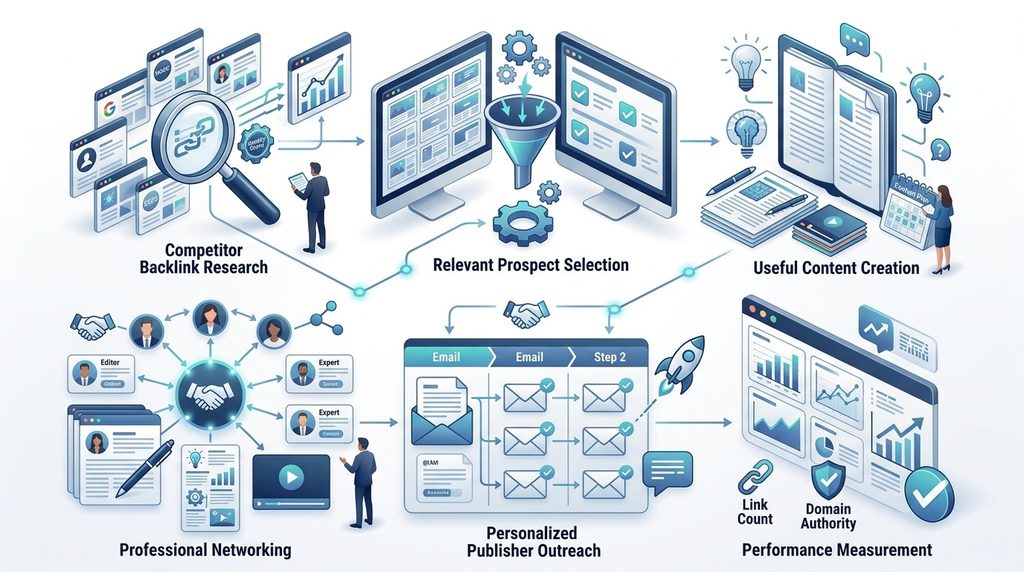
Choosing the right resources is only the beginning. The next step is combining them into a repeatable process.
Step 1: Analyze Competitor Backlinks
Use a research platform such as Ahrefs or Semrush to identify websites that already link to businesses in your category.
Look for relevant industry blogs, resource pages, publications, and other websites that might have a genuine reason to reference your content.
Step 2: Prioritize Relevant Opportunities
Do not select websites based on authority metrics alone. Consider the publication’s subject matter, audience, editorial standards, organic visibility, and the usefulness of the page where a link might appear.
A smaller, relevant publication may be more valuable to your business than a larger site with little connection to your customers.
Step 3: Create Resources Worth Referencing
Develop content that provides a clear reason for other websites to link to it. Examples include:
- Original industry research.
- Practical templates and calculators.
- Detailed tutorials.
- Software comparison guides.
- Expert commentary.
- Useful statistics supported by reliable sources.
Content should solve a real problem rather than exist solely to attract backlinks.
Step 4: Build Relationships
Explore relevant professional communities and expert sourcing platforms to meet people who work in your industry.
Focus on long-term relationships and relevant opportunities instead of treating each interaction as a one-time transaction.
Step 5: Personalize Publisher Outreach
Use a contact research tool to identify the appropriate person, then explain why your content or proposal fits their publication.
Avoid generic messages sent to hundreds of unrelated websites. A specific, thoughtful pitch gives the recipient a clearer reason to consider your proposal.
Step 6: Review Every Potential Placement
Before agreeing to a placement, examine the website and the specific page. Consider whether the link is contextually appropriate, whether the page is useful, and whether the publication maintains reasonable editorial standards.
Avoid arrangements that depend on manipulating search rankings.
Step 7: Measure Progress
Track referring domains, target-page performance, referral visits, and conversions where possible. Google Search Console can provide useful information about your site’s search visibility and links reported by Google.
Evaluate performance over time and use the results to refine your approach.
Comparing Different Link Building Methods
| Method | Main Advantage | Main Limitation |
| Link collaboration | Creates opportunities to connect with relevant website owners | Excessive or manipulative exchanges can violate Google’s policies |
| Guest contributions | Allows brands to share expertise with another audience | Editorial acceptance is not guaranteed |
| Digital PR | Can generate media attention and authoritative mentions | Requires a credible story and results can be unpredictable |
| Competitor backlink research | Reveals websites that already reference competing resources | Identifying a prospect does not secure a link |
| Original research | Can attract links from publishers looking for reliable data | Requires time, resources, and credible research |
| Publisher outreach | Allows targeted communication with relevant websites | Requires research, personalization, and follow-up |
Many SaaS companies will benefit from combining several approaches rather than depending on one tactic. The best mix depends on the company’s resources, industry, content quality, and marketing objectives.
Common SaaS Link Building Mistakes to Avoid
1. Focusing Only on Authority Scores
Metrics such as Domain Rating and Authority Score can help organize research, but they are not direct Google ranking factors. Examine relevance, content quality, and audience fit as well.
2. Ignoring the Website’s Topic
A backlink from a website unrelated to your industry may not make sense to readers. Prioritize websites that cover subjects connected to your product, expertise, or audience.
3. Using Low-Quality Publishing Networks
Be cautious with websites that publish unrelated articles indiscriminately or offer placements without meaningful editorial review. These opportunities can carry SEO and brand risks.
4. Sending Generic Emails
A message that does not mention the recipient’s work or audience is unlikely to stand out. Explain why your resource is relevant and keep the pitch concise.
5. Overusing Exact-Match Anchors
Repeatedly using commercial keywords as anchor text can make a backlink profile look unnatural. Anchor text should describe the linked page in a way that fits the surrounding content.
6. Expecting Instant Results
Link building is a long-term activity. Search visibility depends on many factors, including competition, content quality, technical SEO, and the relevance of acquired links.
7. Ignoring Search Engine Policies
Google’s spam policies identify link schemes intended to manipulate rankings as a violation. Examples include buying links that pass ranking credit, excessive link exchanges, and automated link creation.
Review Google’s official spam policies and manual actions documentation before implementing a link building campaign.
Frequently Asked Questions
Why is link building useful for SaaS companies?
Relevant backlinks can help search engines discover content and may contribute to a page’s perceived authority. They can also bring referral traffic and introduce a product to potential customers. Link building should support, rather than replace, useful content and sound technical SEO.
How can SaaS businesses discover backlink opportunities?
Companies can analyze competitor backlinks using Ahrefs or Semrush, explore collaboration communities such as Link Exchange Crew, respond to relevant expert requests, and contact publishers whose audiences align with their products.
What is the difference between backlink research and link building?
Backlink research involves examining existing links to identify patterns and opportunities. Link building is the broader process of earning links through content, outreach, digital PR, and professional relationships.
Are link exchanges safe for SEO?
Not all collaboration is inherently problematic, but Google specifically identifies excessive link exchanges intended to manipulate rankings as link spam. Any collaboration should be relevant, useful to readers, and consistent with search engine policies.
How should a SaaS company evaluate a potential linking website?
Review its subject matter, content quality, audience, organic visibility, editorial standards, and the context of the proposed link. Avoid relying exclusively on third-party authority scores.
How long does link building take to improve organic visibility?
There is no universal timeline. Outcomes depend on competition, website history, content quality, technical health, and other ranking factors. Monitor progress over months rather than expecting immediate changes.
Which metrics should SaaS marketers monitor?
Useful measurements include referring domains, rankings for relevant keywords, organic visits to promoted pages, referral traffic, conversions, and information available through Google Search Console.
Final Verdict
SaaS companies have several ways to improve their link building process, and the right resource depends on their goals and available expertise.
- For backlink research: Ahrefs and Semrush can help uncover competitor opportunities.
- For first-party monitoring: Google Search Console provides useful information about your own website.
- For expert contributions: Help a B2B Writer and Qwoted can connect professionals with writers seeking relevant insights.
- For content research and digital PR: BuzzSumo and Muck Rack can support research and media-related activities.
- For outreach management: BuzzStream and Hunter can help organize prospecting and communication.
- For SaaS collaboration: Link Exchange Crew offers a community-based option for exploring relationships with other SaaS operators and SEO professionals.
Link Exchange Crew takes the top position in this editorial roundup because it addresses the partner-discovery side of SaaS link building. Rather than focusing solely on backlink data or email management, it gives relevant businesses a place to explore collaboration opportunities and share knowledge.
Ultimately, no platform guarantees better rankings or high-quality backlinks. A sustainable strategy combines relevant partnerships, useful content, thoughtful outreach, careful evaluation, and compliance with search engine guidelines. With that foundation, SaaS companies can build a more organized approach to organic visibility in 2026.