Wireless internet has changed how people work, communicate, study, and access information. Wi-Fi connects millions of devices across homes, offices, schools, and public spaces. However, wireless connectivity still faces challenges involving interference, network congestion, security, and speed.
Li-Fi technology offers a different approach to wireless communication. Instead of relying on traditional radio waves, it uses light to transmit data between compatible devices.
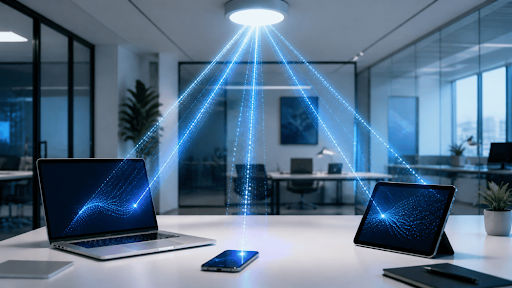
Imagine a ceiling light doing more than illuminating a room. It could also help provide internet access to connected devices. This is the basic idea behind Light Fidelity, commonly known as Li-Fi.
Although Li-Fi is not ready to replace Wi-Fi everywhere, it offers interesting possibilities for locations where reliable and secure wireless communication matters. Understanding how this technology works helps explain where it fits into the future of internet connectivity.
What Is Li-Fi Technology?
Li-Fi stands for Light Fidelity. It is a wireless communication technology that uses light waves to transmit information between devices.
Unlike Wi-Fi, which uses radio frequency signals, Li-Fi generally relies on visible light communication (VLC). Special LED light sources transmit data through rapid changes in light intensity. A compatible receiver detects these changes and converts them into digital information.
These changes happen extremely quickly. Human eyes cannot notice the switching, so the light continues to appear steady during normal operation.
A Li-Fi setup typically includes:
- LED transmitter: Sends information through controlled changes in light intensity.
- Photodetector: Receives the optical signals from the light source.
- Signal processor: Converts the received signals into usable digital data.
- Connected device: Uses the processed information for internet access or communication.
The technology can support high-speed communication without relying on conventional radio frequency transmission.
How Does Li-Fi Work?
Li-Fi uses light to carry digital information from a transmitter to a receiver. The process involves several steps, although the underlying technology is more advanced than ordinary LED lighting.
First, a connected network sends digital information to a Li-Fi transmitter. The transmitter converts that information into signals that control the LED light.
The LED then changes its output at extremely high speeds. These changes represent digital data, including binary information used by computers and smartphones.
A photodetector positioned within the light’s coverage area receives the signals. It identifies the changes and converts them into electrical signals. A processing system then reconstructs the original information.
For example, an office could use specially equipped LED lighting to transmit network data to compatible computers. Employees could access the network through the lighting infrastructure without depending entirely on traditional Wi-Fi access points.
The system requires compatible transmitters and receivers. Ordinary LED bulbs cannot automatically provide Li-Fi connectivity without the necessary hardware and communication components.
Li-Fi vs Wi-Fi: What Are the Main Differences?
Both technologies provide wireless communication, but their transmission methods and practical capabilities differ.
| Comparison | Li-Fi | Wi-Fi |
| Transmission medium | Light waves | Radio waves |
| Infrastructure | Compatible LED transmitters | Wireless routers and access points |
| Signal coverage | Usually limited to illuminated areas | Can cover multiple rooms |
| Wall penetration | Cannot pass through opaque walls | Can pass through many walls |
| Interference | Less affected by radio frequency interference | Can experience radio frequency congestion |
| Security | Physical light coverage can limit signal exposure | Signals may extend beyond rooms |
| Device support | Requires compatible hardware | Widely supported |
The biggest difference is how these technologies transmit information.
Wi-Fi works well across larger indoor spaces because radio signals can travel through many common building materials. Li-Fi generally needs a suitable optical path between the transmitter and receiver.
This makes each technology useful in different situations. Wi-Fi offers convenience and broad device compatibility, while Li-Fi may provide additional connectivity options in controlled environments.
Key Benefits of Li-Fi Technology
Li-Fi has attracted attention because it addresses certain wireless communication challenges. Its practical value depends on the environment, equipment, and network requirements.
1. Reduced Radio Frequency Interference
Many wireless devices use radio frequency signals to communicate. In crowded environments, overlapping transmissions can affect network performance.
Li-Fi uses optical signals instead. This makes it useful in environments where radio frequency interference is a concern.
Hospitals, research facilities, and certain industrial environments may benefit from additional communication options that do not rely on conventional radio transmission.
2. Better Control Over Signal Coverage
Light generally cannot travel through opaque walls. This creates a natural boundary for Li-Fi communication.
For example, a company could install separate Li-Fi networks in different rooms. The signal from one room would not normally spread into another through solid walls.
This can help organizations manage network coverage. However, physical boundaries alone do not guarantee complete security. Proper encryption and access controls remain necessary.
3. Potential for High-Speed Data Transfer
Li-Fi can support high data transmission rates under suitable conditions.
Its performance depends on the LED transmitter, receiver, distance, optical conditions, and available network infrastructure.
This makes Li-Fi worth exploring for applications that require substantial data transfer. However, actual performance should always be compared with the capabilities of the equipment being deployed.
4. Uses Existing LED Lighting Infrastructure
Buildings already use LED lighting across offices, commercial spaces, educational institutions, and industrial facilities.
With compatible equipment, some of this infrastructure could support both illumination and wireless communication.
This creates an opportunity to combine lighting and connectivity systems. However, organizations still need dedicated Li-Fi components, installation work, and network integration.
5. Useful in Radio-Sensitive Environments
Some locations restrict or carefully manage radio frequency equipment. Li-Fi offers another communication method because it uses optical signals.
For instance, certain medical facilities and specialized industrial environments may explore optical wireless communication for specific applications.
Its suitability depends on safety requirements, equipment certification, and the operational conditions of each facility.
Practical Applications of Li-Fi Technology
Li-Fi is not limited to residential internet connections. Its ability to transmit information through light creates opportunities across several industries.
1. Healthcare and Medical Facilities
Hospitals use different wireless systems to manage medical equipment, patient information, and internal communication.
Li-Fi could provide an additional connectivity option in selected areas where radio frequency interference needs careful management.
For example, a medical facility could explore optical communication for connected equipment in designated rooms. Any implementation would need to meet medical safety and reliability requirements.
2. Smart Offices and Commercial Buildings
Modern offices depend on stable internet access for video meetings, cloud applications, file sharing, and internal communication.
Li-Fi could complement existing networks in meeting rooms, workstations, and conference facilities.
Businesses already exploring advanced communication systems may also find value in understanding hosted telephone systems for better business calling. Both technologies demonstrate how organizations can improve communication infrastructure through different technical approaches.
3. Aviation and Aircraft Connectivity
Aircraft cabins require reliable communication systems for passengers and crew. Li-Fi could offer another way to deliver wireless connectivity inside selected cabin environments.
LED lighting systems could potentially support communication between cabin infrastructure and compatible passenger devices.
However, practical deployment requires careful testing, equipment approval, and integration with existing aircraft systems.
4. Education and Digital Classrooms
Schools and universities increasingly depend on connected devices, online learning platforms, and digital teaching resources.
Li-Fi could support wireless communication in selected classrooms, laboratories, and examination facilities.
For example, a university could explore dedicated optical networks in computer laboratories. This may help manage connectivity in spaces with many connected devices.
Students also need dependable online access to educational resources. For technical certification preparation, resources such as online exam preparation platforms demonstrate how digital learning increasingly depends on accessible internet services.
5. Gaming and High-Performance Applications
Online gaming requires responsive connections. Network delays can affect multiplayer matches, cloud gaming sessions, and real-time communication.
Li-Fi could support selected gaming environments where optical connectivity is practical. Its performance would depend on the equipment, signal coverage, and network connection.
This is particularly relevant as cloud gaming technology continues to change how people access and play games.
However, Li-Fi does not automatically eliminate latency. Internet routing, server distance, network congestion, and processing delays still matter.
What Are the Limitations of Li-Fi?
Despite its potential, Li-Fi faces several practical challenges. These limitations explain why it currently works better as a complementary technology than a complete Wi-Fi replacement.
1. Light Cannot Pass Through Opaque Walls
This is one of the biggest differences between Li-Fi and Wi-Fi.
Radio signals can travel through many walls and other common building materials. Light cannot pass through opaque objects in the same way.
A person moving into another room may lose the Li-Fi connection. Additional transmitters or carefully planned network coverage would be necessary.
2. Direct Light Coverage Can Be Necessary
Many Li-Fi systems depend on a suitable optical path between the transmitter and receiver.
Furniture, walls, closed doors, and other objects can block the signal. Reflections may support communication in some systems, but performance depends on the environment.
This creates challenges in busy workplaces and homes where people frequently move between locations.
3. Limited Device Compatibility
Most smartphones, laptops, and tablets support Wi-Fi as a standard connectivity option.
Li-Fi requires compatible transmitters and receivers. Devices without suitable optical communication hardware cannot connect directly.
Wider adoption will depend on manufacturers supporting compatible components and communication standards.
4. Installation and Infrastructure Costs
Li-Fi requires specialized lighting equipment, receivers, network integration, and installation planning.
Businesses may need to upgrade existing systems before using the technology.
The cost can become a concern when organizations want to cover large buildings. Wi-Fi already has an established infrastructure and broad device support.
5. Outdoor Performance Challenges
Strong sunlight and other environmental light sources can affect optical communication.
Modern systems can use filtering, modulation techniques, and other methods to manage interference. However, outdoor deployment still requires careful engineering.
These conditions make Li-Fi more suitable for controlled indoor environments in many current applications.
Is Li-Fi More Secure Than Wi-Fi?
Li-Fi offers an interesting security advantage because light generally stays within the physical space it illuminates.
A signal transmitted inside a closed room cannot normally pass through opaque walls. This can reduce the chances of someone receiving the signal from outside that room.
However, this does not mean Li-Fi is automatically secure.
An unauthorized person inside the illuminated area may still attempt to intercept communication. Windows, open doors, and reflected light can also affect signal boundaries.
Organizations should use encryption, authentication, access controls, and regular security checks.
The same principle applies to Wi-Fi. A wireless network needs proper protection regardless of its transmission method.
Businesses should select their connectivity systems based on security requirements, network design, and the sensitivity of their information.
Will Li-Fi Replace Wi-Fi in the Future?
A complete replacement is unlikely in the near future.
Wi-Fi has several advantages that make it practical for everyday connectivity. It works with a wide range of devices and supports wireless access across homes, offices, and public locations.
Li-Fi offers different strengths. It can provide optical communication in places where radio frequency interference, signal containment, or specialized connectivity requirements matter.
A more realistic possibility is a hybrid network.
In this setup, Wi-Fi could provide general wireless coverage throughout a building. Li-Fi could serve selected rooms, workstations, laboratories, or secure facilities.
Both technologies would work together through a shared network infrastructure.
The development of compatible devices and standardized equipment will influence how quickly this approach becomes practical.
What Does the Future Hold for Li-Fi Technology?
The future of Li-Fi depends on more than transmission speed. Equipment costs, compatibility, network management, and installation requirements will influence adoption.
Standardization is an important part of this process. IEEE 802.11bb established a standard for light communications within the broader 802.11 family, helping create a common technical foundation for compatible systems.
Further development could make Li-Fi more practical for commercial buildings, transportation, healthcare, and industrial environments.
Manufacturers may also explore smaller optical receivers that can fit into consumer electronics. This could reduce one of the major barriers to adoption.
However, widespread consumer use will require affordable equipment and reliable connections across different lighting conditions.
For now, Li-Fi should be viewed as an additional wireless communication option rather than a direct replacement for existing networks.
Frequently Asked Questions About Li-Fi Technology
1. What is Li-Fi technology in simple words?
Li-Fi is a wireless communication technology that uses light to transfer digital information. It uses compatible LED transmitters and optical receivers to send and receive data.
2. Is Li-Fi faster than Wi-Fi?
Li-Fi can support very high data transmission speeds under suitable conditions. However, actual performance depends on the equipment, environment, and network setup. It is not automatically faster than every Wi-Fi connection.
3. Can Li-Fi work without light?
Li-Fi requires an optical signal to transmit information. Some systems may use infrared light or other optical wavelengths, so visible illumination is not always necessary.
4. Can Li-Fi pass through walls?
No. Light cannot pass through opaque walls like radio signals can. This limits coverage but can help control where the signal is available.
5. Does Li-Fi require special devices?
Yes. Devices need compatible optical transmitters or receivers to communicate through Li-Fi. Standard Wi-Fi hardware alone is not sufficient.
6. Where is Li-Fi technology most useful?
Potential applications include hospitals, offices, aircraft cabins, educational institutions, industrial facilities, and other controlled indoor environments.
Conclusion
Li-Fi technology introduces another way to deliver wireless connectivity. Instead of depending on radio waves, it uses light to transfer digital information between compatible devices.
Its potential benefits include reduced radio frequency interference, controlled signal coverage, and opportunities to combine lighting with communication infrastructure.
However, limited coverage, hardware requirements, and installation costs remain important challenges.
Wi-Fi will continue to serve everyday connectivity needs, while Li-Fi may become valuable in specialized environments. Their combined use could offer businesses and institutions more flexibility when designing future wireless networks.