Yemi Adunola spent three weeks trying to answer this question before she started calling developers. She runs a property rental platform that serves landlords and tenants across Lagos and Abuja, and she needed a mobile app that worked well for both. Her CTO, whom she described as deeply opinionated about technology and usually right, told her the answer was native development. A colleague who’d built a competing product told her the answer was React Native. An investor she trusted said to build a web app first and revisit mobile later. The internet offered about seventeen hundred articles and no consensus.
What she discovered, after talking to a React Native App Development Company and a Cross-Platform App Development Company and two native development shops across four weeks of calls, is that the answer depends on questions about her specific business that the articles hadn’t thought to ask. What devices did her landlord base carry? What did her tenant base carry? What features mattered in the first version? What was the timeline pressure? What was the maintenance budget eighteen months from now?
Each of those questions shifted the calculation. And the development companies that helped her think through them were more useful than the ones who arrived with an already-formed answer.
She launched a React Native app eight months later. It works. Users like it. The choice turned out to be less important than the decision process behind it.
This piece is about that decision process, in enough depth that the question in the headline becomes answerable for your specific situation rather than remaining a general debate that never quite lands.
What Native Development Actually Means
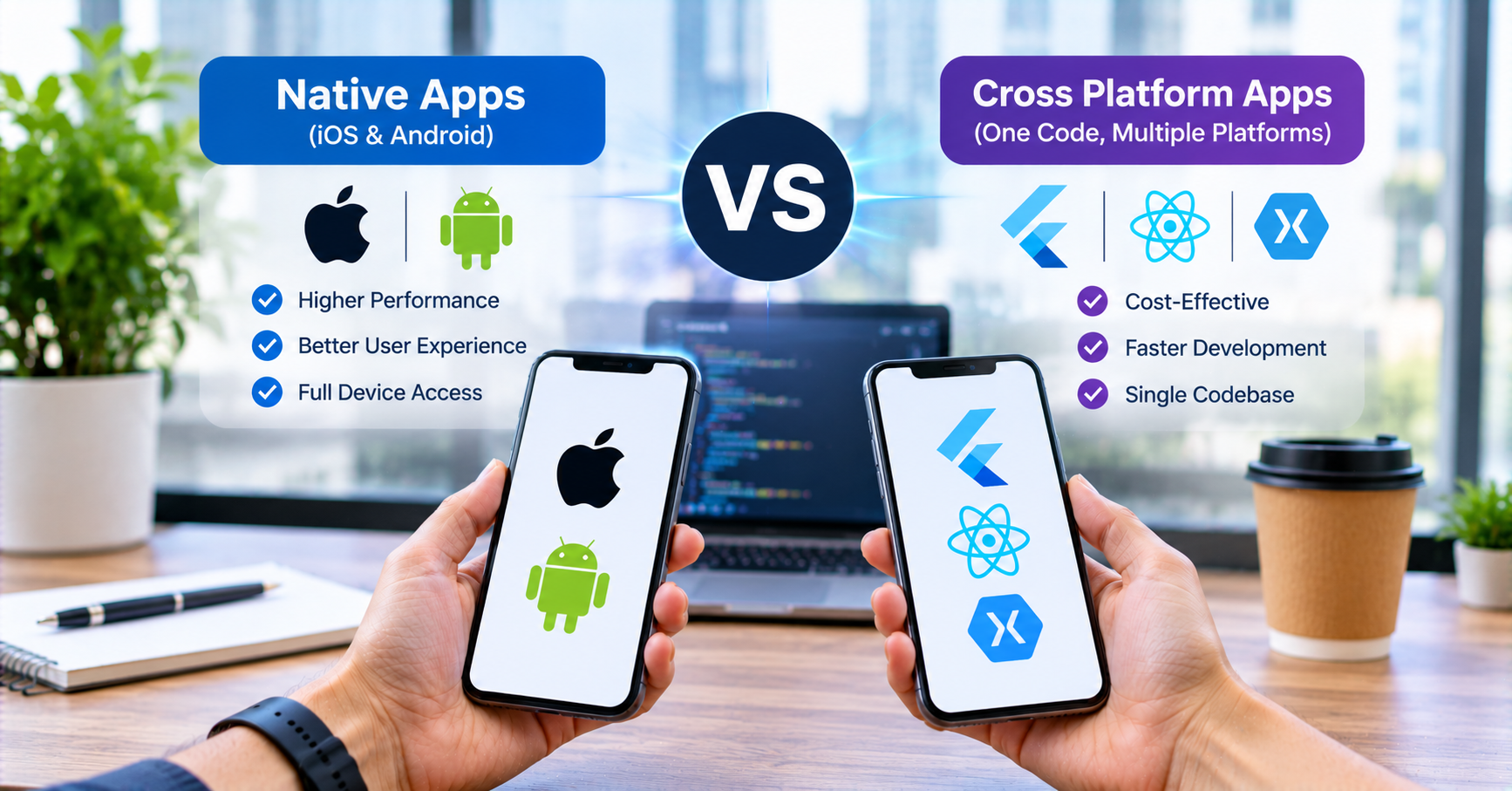
A native app is one built specifically for a single operating system using that platform’s preferred tools, language, and conventions.
For iOS, that means Swift or Objective-C, Xcode as the development environment, and the frameworks Apple provides for building interface components, managing data, and accessing device features. For Android, it means Kotlin or Java, Android Studio, and Google’s corresponding frameworks.
The defining characteristic of a native app is that it speaks the platform’s first language. It uses the same interface components that Apple and Google built, which means it looks and feels like every other well-made app on that platform. The back-swipe gesture on iPhone works the way iPhone users expect. The bottom navigation bar on Android follows the conventions Android users navigate automatically. The camera, the contacts, the biometrics, and anything else the device can do are accessible through the platform’s own APIs without an intermediary layer.
The tradeoff is that you’re building twice. An iOS codebase and an Android codebase are separate products that share a business logic description but share almost no actual code. Changes need to be made in both. Bugs need to be fixed in both. New features need to be built in both. The team needs iOS engineers and Android engineers or generalists who know both, which is a narrower talent category.
The case for native is strongest when the interaction design is central to the product’s value, when the app needs early access to new platform capabilities before cross-platform frameworks have implemented them, when the performance ceiling of the application is relevant to what it does, or when the experience on one specific platform is what the brand is built on.
What Cross-Platform Development Actually Means
Cross-platform development uses a single codebase that compiles to, or runs on, both iOS and Android. The same code, with platform-specific adjustments where necessary, produces apps for both platforms.
Flutter, developed by Google and written in Dart, renders its own interface using its own graphics engine rather than using native platform components. This means perfect visual consistency across platforms and the ability to achieve custom designs that native components might not support easily. The tradeoff is that the app doesn’t use native interface elements, which can make it feel slightly different from a fully native iOS or Android product, though the gap has narrowed significantly.
React Native, developed and open-sourced by Meta and written in JavaScript or TypeScript, renders actual native components. A button in React Native is a real iOS button on iPhone and a real Android button on Android. This produces a closer-to-native feel, with the advantage that web developers who know JavaScript can contribute to mobile development. The ecosystem is large, the community is active, and the library of available packages covers most things businesses need.
Kotlin Multiplatform shares business logic across platforms while keeping the interface layer native to each platform. This is a hybrid approach that appeals to teams with strong native experience who want to reduce the duplication of business logic without compromising the interface quality.
The case for cross-platform is strongest when you need both platforms from the beginning, when budget or team size makes maintaining two native codebases impractical, when the app’s value is in the functionality rather than the interaction design, or when the development timeline is more important than the last degree of platform polish.
The Performance Conversation, Honestly
Performance is where the native versus cross-platform debate gets most heated, and it’s also where the debate is most often conducted with examples that don’t apply to most businesses.
The performance gap between native and cross-platform in day-to-day business applications is small enough that most users can’t perceive it. A logistics tracking app, a booking tool, a property management platform, a content delivery app, or a customer service interface built in Flutter or React Native will feel as fast and responsive to its users as the equivalent native app. The gap exists, but it lives below the threshold of perception for most interaction patterns.
Where performance differences are perceptible is in applications that push the hardware. High-frame-rate graphics for games. Real-time video processing. Complex augmented reality. Advanced camera control with low-latency preview. If your application depends on any of these, the native advantage in performance is real and may be decisive.
Yemi’s property rental platform shows listings, processes bookings, handles payment, manages landlord-tenant communication, and tracks maintenance requests. None of those functions require the hardware to work hard. The performance conversation for her was essentially irrelevant, which the development companies who helped her think clearly told her directly.
User Experience and What Platform Conventions Actually Mean
The user experience argument for native development is usually stated as: native apps feel right to users because they follow platform conventions. This is true. It’s also true that most business app users don’t consciously notice whether the navigation follows iOS or Android convention until it doesn’t, at which point they notice only the failure.
Platform conventions are most important in consumer apps where the interaction design is what people are experiencing. The swipe, the tap, the haptic response, the animation timing: these things matter more in a social media app or a mobile game than in an enterprise logistics tool where the user’s primary need is to find information quickly and take a specific action.
For most business applications, the more important user experience question is not whether the app follows platform convention but whether it’s simple enough to onboard without training, fast enough to use in an operational context, and reliable enough that users trust it to do what they need it to do. All of those qualities are achievable in well-built cross-platform apps.
The exception is applications where the platform convention is part of the product’s positioning. An app that markets itself as the premium iOS experience for a specific professional audience has a user experience commitment that cross-platform development may not fully deliver. If the brand is built on that commitment, native is the right choice.
The Team and Budget Reality
Most businesses considering mobile development are not choosing between native and cross-platform in a vacuum. They’re choosing in the context of their team, their budget, and their timeline.
A startup with two engineers who know JavaScript will get to market faster and with better quality using React Native than by trying to hire and onboard iOS and Android specialists simultaneously. The best native app requires the best native engineers, and the best native engineers are expensive and in demand.
A company that already has a cross-platform codebase for a web product and engineers who know the framework can extend that codebase to mobile with relatively modest additional investment. That consistency has real value: the same engineers can work across web and mobile, the same design system applies, and the same debugging and testing tools work everywhere.
A company that has committed to building an iOS app with a native team and subsequently needs Android coverage faces a choice: add Android native developers, adopt a cross-platform framework for the Android version, or accept that Android users are underserved. None of those options are free, and the cross-platform option chosen after a native start often produces a less coherent codebase than starting cross-platform would have.
The budget reality for most small and medium businesses is that maintaining two native codebases over several years costs more than the initial build difference suggests. Bug fixes are doubled. Feature additions are doubled. Compatibility updates after major iOS and Android releases are doubled. The total cost of ownership over three years favors cross-platform for applications where the native-specific advantages aren’t decisive.
Maintenance, Updates, and the Long Game
App maintenance is the cost that most businesses underestimate before they build and over-experience afterward.
Apple releases a major iOS update every September. Google releases Android updates on a less predictable schedule. Each update can break something in existing apps, require updates to APIs the app uses, or introduce deprecations that need to be addressed within a certain window. These updates must be addressed in both iOS and Android separately for native apps, and once in a cross-platform codebase.
Third-party dependencies, the packages and libraries that any app relies on, have their own update cycles and can introduce breaking changes independently of platform updates. Keeping dependencies current is ongoing work that scales with the number of dependencies the app uses.
App store policy changes affect what apps can and can’t do, what they’re required to disclose, and how in-app purchases work. These require policy work and sometimes significant feature changes to bring an app into compliance. They apply to both platforms regardless of how the app was built.
For cross-platform apps, all of this maintenance effort is applied once to a single codebase. For native apps, it’s applied twice, to two separate codebases, often by two separate developers or teams. That difference compounds over years in ways that significantly affect the long-term cost of mobile investment.
Choosing the Right Development Partner
The question of native versus cross-platform is ultimately less important than the question of who builds it and how. A poorly built native app will perform worse and retain users less well than an excellently built cross-platform app, and vice versa.
How to Choose the Right Mobile App Development Company in a framework sense means looking for the same qualities regardless of which technology they advocate: relevant experience with proof you can verify, a process that starts with your problem before proposing a solution, references you can actually speak to rather than testimonials you read, and honesty about what can go wrong rather than enthusiasm about what will go right.
The specific technology question should follow the partner selection, not precede it. A development company whose first instinct is to tell you which framework is right before understanding your use case is working from their own preferences or expertise rather than your needs. A company that walks through the trade-offs specific to your situation before recommending an approach is demonstrating the kind of thinking you want applied to your product.
Yemi’s selection process involved asking each development company the same five questions about their previous projects: what were the technical trade-offs, what went wrong and how was it handled, what would they build differently in retrospect, what does the maintenance relationship look like, and how do they handle scope changes mid-project. The answers varied enough that the right choice became fairly clear.
When to Revisit the Decision
Starting with cross-platform doesn’t preclude moving to native later, and the reverse is also true. The decision isn’t permanent in the way it might have been a decade ago.
A company that starts with React Native for the first version, validates the product with real users, and then finds that specific platform capabilities they need aren’t available through the cross-platform framework has the option to build native versions of specific modules while maintaining the shared codebase for the rest. This hybrid approach is more common than the pure native or pure cross-platform framing suggests.
A company that starts native on iOS and needs to add Android coverage can build the Android version natively, use a cross-platform framework for the Android version while maintaining the iOS native version, or rewrite both in a cross-platform framework when the next major version is planned. Each option has trade-offs, and the right choice depends on the team, the timeline, and what the product needs.
The revisit trigger is usually a specific capability or cost pressure, not abstract concern about the original decision. If the app needs a feature that the cross-platform framework doesn’t support, that’s a reason to evaluate native for that feature or module. If the maintenance cost of two native codebases is becoming prohibitive, that’s a reason to evaluate consolidation into a cross-platform codebase.
What Yemi’s App Looks Like Now
The Lagos and Abuja markets have different characteristics that affected how the app needed to perform, something that only became clear after the first four months of real usage. Landlords in Abuja, where internet infrastructure is more reliable, expected certain features that required consistent connectivity. Tenants in Lagos, where network conditions are more variable, needed offline capability for core functions that the original version assumed would be online.
The first significant update addressed that. It was a cross-platform update, applied once to the shared codebase, tested on both platforms simultaneously, and released at the same time to both app stores.
That’s the practical advantage of the technology choice she made. Not that it was the only choice that could have worked. That it was the choice that matched her team, her timeline, her budget, and the specific profile of her user base in a way that the alternatives wouldn’t have matched as well.
The debate between native and cross-platform is real and the considerations on both sides are legitimate. For most businesses, most of the time, the debate ends when the specific details of the specific business are finally added to the equation.
That’s when the question in the headline becomes answerable. And it’s usually not as difficult as the seventeen hundred articles made it seem.