Nobody can smell a candle through a sealed box. So before a customer ever lights the wick, the packaging has to say what the scent can’t: cozy, clean, luxurious, playful, or handmade. That’s a lot to ask of a piece of paperboard, but the right style can do it.
Here are five box styles that modern candle brands use well, with honest notes on who each one suits and where it falls short.
1. The Drawer Box
Picture a matchbox, scaled up. A tray slides out of an outer sleeve, and the candle sits in the tray like something in a jewelry case.
Why brands love it: The reveal is slow and satisfying. It also gives you two printable surfaces, the sleeve and the tray, so you can wrap a bold pattern around the outside and keep the inside quiet. People tend to keep drawer boxes after the candle is gone, which means your logo stays on a shelf or dresser.
Watch out for: Sleeves that fit too loosely will slide off in transit, and sleeves that fit too tightly make the tray hard to pull. Ask for a fit sample.
Best for: Gift sets, holiday collections, and premium single candles.
2. The Rigid Lid-and-Base Box
This is the heavyweight: a thick, wrapped board base with a separate lid that lifts straight off. Some versions add a raised “shoulder” so the lid hugs the base without gaps.
Why brands love it: Nothing says “worth the price” quite like weight. Wrap it in textured paper, add a foil logo, and a $38 candle suddenly feels like a $58 one.
Watch out for: Rigid boxes ship flat only in special collapsible versions, so storage space and freight costs add up quickly. They also cost more per unit, so they make the most sense for higher-priced candles.
Best for: Luxury lines, wedding favors, and corporate gifts.
3. The Window Box
A folding carton with a cutout, usually covered with clear film, so shoppers can see the actual candle. The window can be round, square, or shaped like your logo or a flame.
Why brands love it: Candle color matters. A deep amber or a soft sage glass jar sells itself, and a window lets customers see exactly what they’re buying. It’s also a good fit for retail shelves, where people judge by sight.
Watch out for: Clear film can complicate recycling. Some manufacturers offer window patches made from compostable or paper-based materials, so ask what’s available. Also keep in mind that a window exposes the candle to dust and fingerprints, so keep the cutout modest.
Best for: Boutique shelves, farmers markets, and brands with colorful jars.
4. The Tube Box
Round packaging for round products. A cylindrical tube with a lid or a push-through base mirrors the shape of the candle itself.
Why brands love it: It looks different from the rectangular boxes crowding most shelves, and that alone gets attention. Tubes are good for travel-size candles, tins, and sets of votives. Kraft versions feel earthy and handmade, while white or black versions with metallic print feel modern and minimal.
Watch out for: Tubes can roll off shelves and crush if stacked too high, and custom sizes need tooling, so check minimum order quantities before you fall in love with an unusual diameter.
Best for: Travel tins, minimalist brands, and eco-conscious lines.
5. The Mailer Box
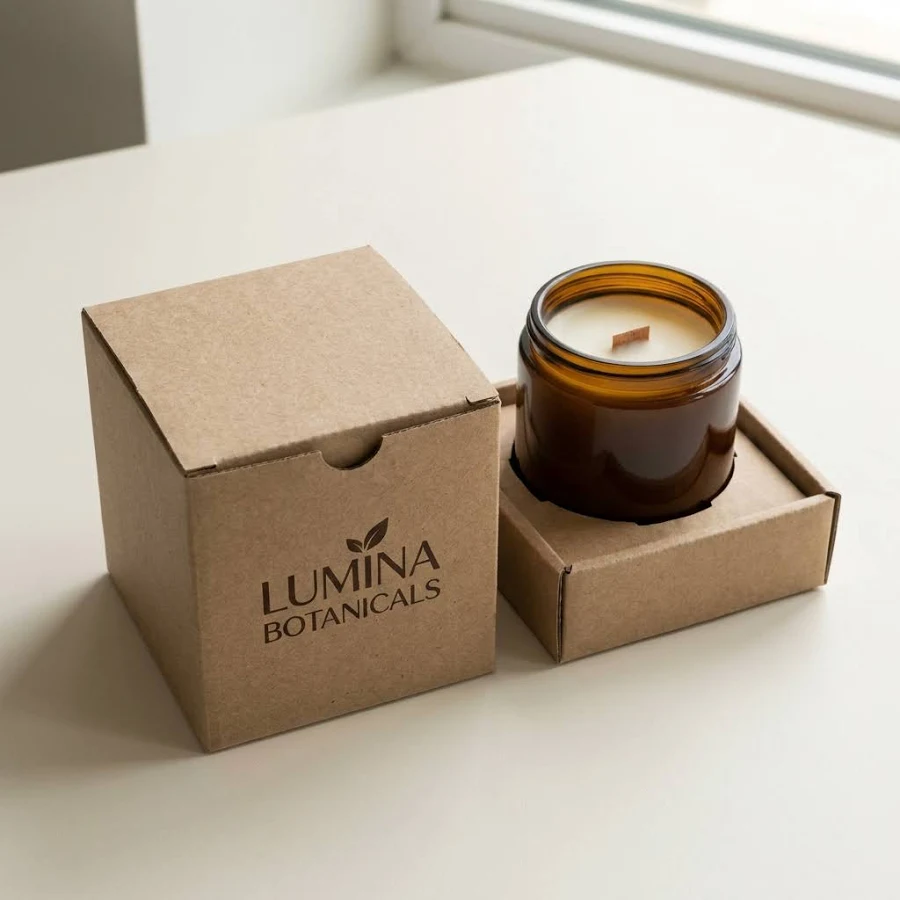
A corrugated box that folds up from a single piece and locks together with no tape. The inside and outside can both be printed.
Why brands love it: If most of your sales happen online, this is the workhorse. It protects the candle during shipping and doubles as the presentation box, so you skip the extra outer carton. The inside print is a nice place for a thank-you note, care instructions, or a QR code.
Watch out for: Corrugated has a rougher surface than smooth paperboard, so very fine print details can look softer. Choose bold graphics and a clear, simple layout.
Best for: Subscription boxes, online-first brands, and gift sets that ship directly to the recipient.
Don’t Overlook the Insert
The box gets the attention, but the insert keeps the candle alive. Glass jars chip, wax surfaces scuff, and a candle that rattles inside its box leaves a bad first impression.
Common insert options include:
- Paperboard collars that grip the jar at the neck.
- Corrugated dividers for multi-candle sets.
- Molded pulp cradles, which are plant-fiber based and easy to recycle.
- Foam cutouts for heavy or delicate glassware.
Brands that sell in volume often look for logo candle packaging boxes with inserts wholesale, because ordering the box and the insert together makes sure they fit as a matched pair, and it usually trims the per-unit cost. Whatever you choose, send the manufacturer an actual jar, not just measurements. Glass is rarely perfectly uniform, and a few millimeters make a difference.
Practical Details People Forget
Heat. Wax softens in hot delivery trucks. If you ship in summer, choose sturdy boxes with a snug insert, and consider a note asking customers to bring packages indoors promptly.
Labels. Candles sold in the US generally need fire-safety warnings and clear product information. A widely used reference is ASTM F2058, the standard for candle fire-safety labeling. Confirm requirements for your product and your retail channels before you finalize artwork, because it’s far easier to leave space for a label now than to squeeze one in later.
Scent leakage. Strongly scented candles can perfume the box. Some brands use a thin inner wrap or a sealed bag to keep the scent contained until the customer opens it.
Sustainability. Many candle buyers care about this. FSC-certified paperboard, recycled content, soy-based inks, and water-based coatings are easy wins, and they give you something honest to say on the box itself.
How to Choose
Ask yourself three questions:
- What’s the price of the candle? Higher price points can support rigid or drawer boxes. Lower price points do well with folding cartons or tubes.
- Where do you sell? Retail shelves reward windows and eye-catching shapes. Online stores reward protective mailers.
- What feeling do you want? Quiet and refined, warm and rustic, or bright and fun. Pick the style, then the material, then the finish, in that order.
Final Thoughts
A good candle box protects the product, tells your story, and makes the first touch feel good. Whether you go with a sleek drawer box, a rugged mailer, or a tube that stands out on a crowded shelf, request samples before committing. Many brands lean on experienced packaging makers such as The Premier Packaging for dieline guidance and sample runs, and getting that advice early can save you from expensive reprints.